
SERVICE 13 / 12
A new colour. With armor built in.
From ₹1,00,000Full body, hatchback. Range ₹1,00,000–₹2,00,000 by car size and finish.All service prices are indicative. Final quote is confirmed after a free inspection.
What is Colour PPF?
Colour PPF is a pigmented paint protection film that changes your car's colour while protecting it. Unlike a vinyl wrap, it is a 190-micron self-healing TPU layer — so you get a full colour change and genuine stone-chip protection in a single film. Carsuit Mumbai offers 350+ colour films in gloss, satin and matte, from ₹1,00,000 to ₹2,00,000 with a 5-year written warranty.
Your car in Ferrari Red, gloss finish. Indicative from ₹1,30,000.
Interactive — the Colour Studio
Build your car in a new colour.
Pick your car, pick a film from our 363-colour range, pick a finish. Lock it and send the spec straight to the studio on WhatsApp.
Illustration, not a photo of your car — the real film is at the studio.
- Vehicle
- Your car
- Film
- Ferrari Red
- Finish
- Gloss
₹1,30,000from
All service prices are indicative. Final quote is confirmed after a free inspection.
01 — Your car
02 — Colour
Ferrari Red
Screen colours are indicative. Pearl, shift and diamond films change with the light — see the real swatch at the studio before you commit.
03 — Finish
Wet, deep, mirror-like. The showroom default.
Gloss, satin and matte are separate films, not a coating over one colour — so switching finish switches you to the films made in it.
A wrap changes how your car looks. Colour PPF changes how it looks and what it can survive. It is the same self-healing thermoplastic urethane we install as clear armor — only pigmented — so the film that carries your new colour is also the film taking the stone chips on the Sea Link.
The factory paint underneath is never touched. No sanding, no respray, no colour-change entry on the RC that a valuer has to think about. When the film comes off years later, the original paint is exactly as it left the factory — which is the single biggest argument for colour PPF over a repaint.
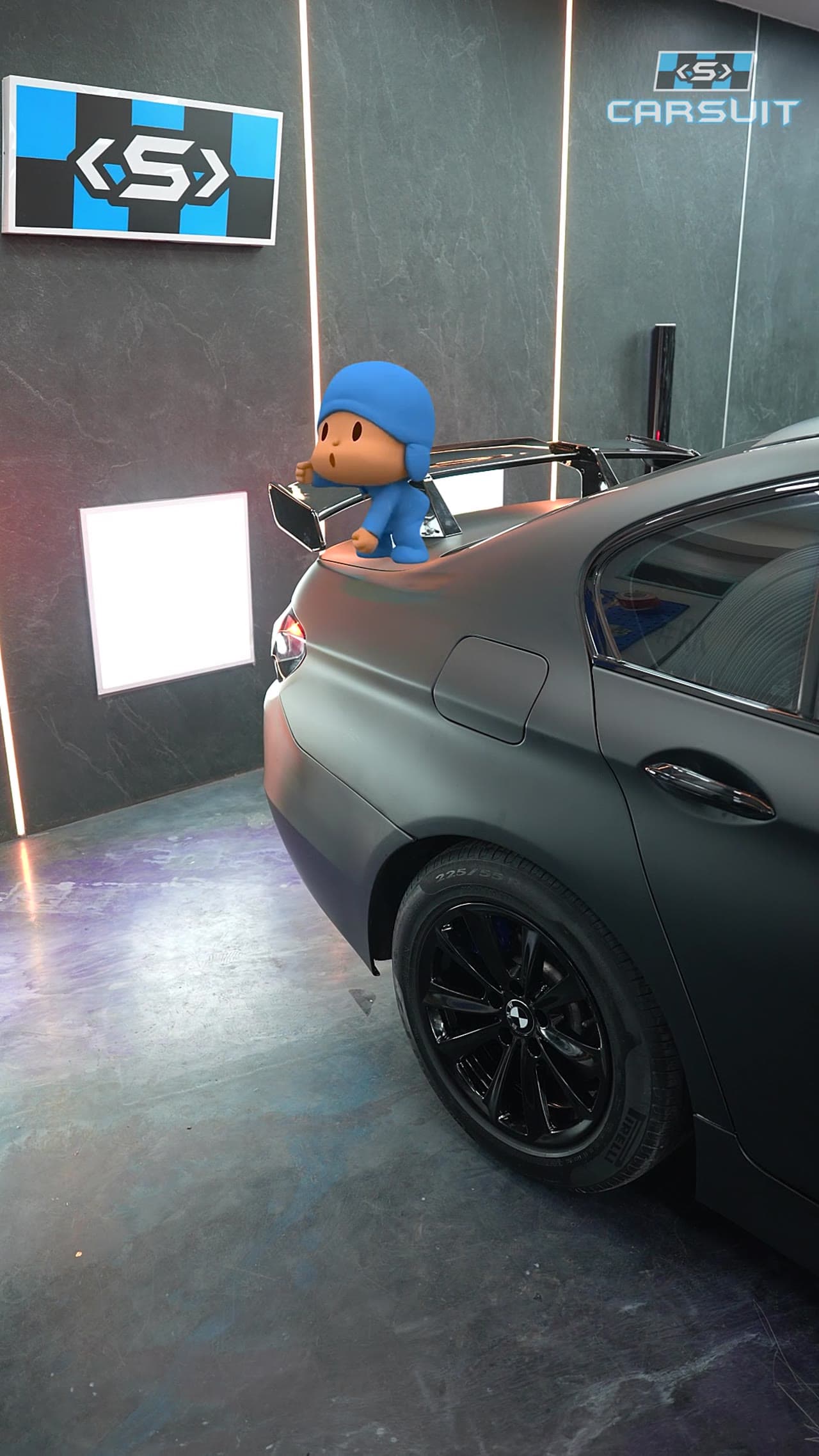
The finish menu is the fun part: gloss, satin and matte pigments, including stealth blacks and the deep metallics that vinyl struggles to hold. And because it self-heals, the swirl marks that make a matte wrap look tired after one Mumbai monsoon simply lift out with heat.
The Carsuit process
01Inspection
Paint depth reading, panel-by-panel damage log, and a written scope before anything touches the car.
02Prep
Decontamination wash, clay, iron remover, and machine polish so the surface underneath is flawless.
03Application
Climate-controlled bay, plotter-cut patterns, edge-wrapped installation by certified applicators.
04Cure
Controlled curing with infrared assist — no shortcuts, no rushed handovers.
05QC
150-point light-tunnel inspection. If we can see it, we redo it.
06Delivery
Walkthrough, care instructions, and your Carsuit Protect™ e-warranty issued on the spot.
Options & tiers
Choose your spec.
All service prices are indicative. Final quote is confirmed after a free inspection.
In detail
Everything worth knowing.
What Colour PPF actually is
Colour PPF is a pigmented paint protection film — a 190-micron thermoplastic urethane layer with the colour built into the film itself. It is installed over your existing paint, plotter-cut to your car's exact panels and wrapped around every edge, so the car leaves with a new colour and a layer of genuine impact protection in one step.
The word that matters is urethane. A vinyl wrap is a decorative film, typically 80–100 microns, with no impact absorption and no ability to heal. Colour PPF is the same self-healing TPU we install as clear armour, only pigmented — so the layer carrying your new colour is also the layer taking stone chips on the Sea Link.
Underneath, your factory paint is untouched. No sanding, no primer, no respray. That single fact is what separates a colour change you can undo from one you cannot, and it is the reason colour PPF and a repaint are not really competitors at all.
Colour PPF vs vinyl wrap vs repaint
A vinyl wrap is the cheapest route to a new colour and the weakest. It changes how the car looks and protects against almost nothing; in Mumbai's sun and monsoon a mid-grade wrap starts lifting at the edges and fading within a couple of years. It is the right answer for a short-term look or a commercial livery, not for protecting a car you care about.
A repaint is permanent, and that permanence cuts both ways. It looks superb when done properly, but it puts a colour-change entry on your record, it can never be reversed to factory paint, and a used-car valuer will read the paint-depth gauge and price accordingly. A respray is also the only one of the three that removes value from a car in good original paint.
Colour PPF sits between them and beats both on the things that matter over five years: it changes the colour like a wrap, protects like PPF, self-heals light swirls with heat, and comes off cleanly in our studio leaving the original paint exactly as it left the factory. It costs more than vinyl up front and less than a quality respray — and unlike the respray, it is reversible.
Gloss, satin or matte — how each behaves
Gloss is the showroom finish: deep, wet-looking, and the most forgiving to live with. It mirrors the sky, it makes metallics and candy pigments look their best, and it washes easily because there is no texture for dirt to key into. If you want the car to look like it just rolled off a stand, gloss is the answer.
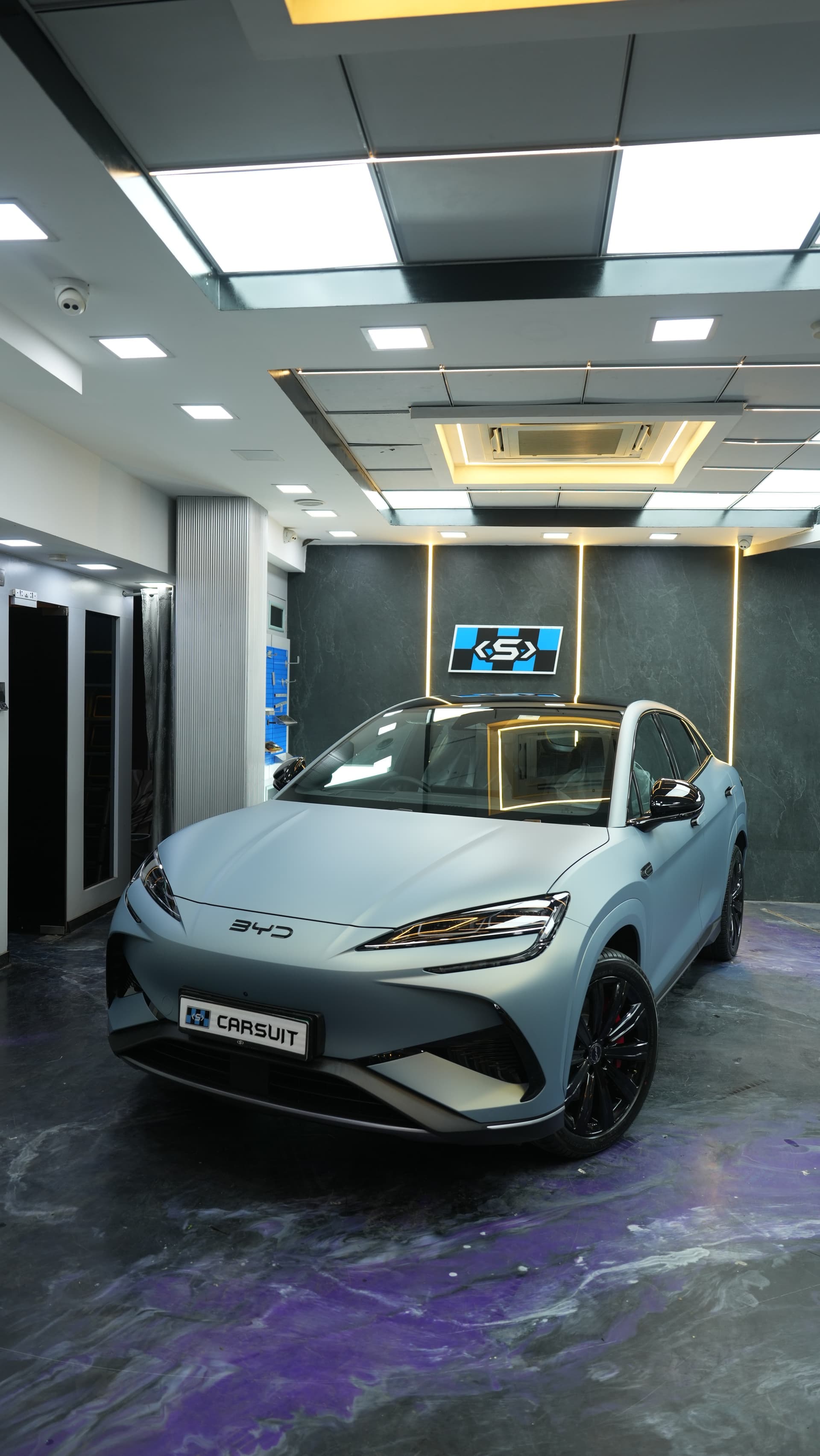
Satin is the half-way finish and, for many owners, the smart one. It has a soft sheen rather than a mirror, which means it hides wash marks, light swirls and the general abuse of Mumbai traffic far better than gloss. On dark colours especially, satin reads expensive without shouting.
Matte eats light completely. Nothing reflects, panel shapes read as pure form, and a stealth black or a matte military green is genuinely striking. The trade-off is care: matte cannot be polished the way gloss can, so it needs pH-neutral washing and no automated brush washes. We hand every matte customer a care card, and our Carsuit Protect™ warranty covers the film either way.
The colour range — and how to choose from it
Our Colour PPF catalogue runs to over 350 films, which is more choice than anybody can process on a phone screen. That is exactly why the Colour Studio above exists: pick your car, filter by family, and see the colour on a car shape before you commit to anything.
The range covers the obvious families — blacks, greys and silvers, whites, reds, blues, greens, purples and pinks — plus the ones that sell themselves in person: liquid metallics that shift with the light, diamond and pearl films that sparkle under sun, colour-shift films that read one colour head-on and another down the flank, and true carbon-fibre textures for roofs, mirrors and bonnets.
Some films exist only in one finish. A colour-shift film needs a gloss or satin carrier to do what it does, and a matte film is not sold as gloss. The Colour Studio knows which is which and will tell you rather than let you build a spec we cannot deliver.
What Colour PPF costs in Mumbai
Carsuit Colour PPF runs ₹1,00,000 for a hatchback up to ₹2,00,000 for a large SUV or exotic, with a 5-year written warranty. Satin and matte finishes carry a ₹20,000 premium over gloss, because the films cost more and are less forgiving to install.
Three things move the number: the size and panel count of the car, the finish, and the condition of the paint underneath. Film goes on best over healthy paint, so a car with heavy swirling or failing clear coat may need correction first — we tell you that at inspection, not after the deposit.
Partial work is often the smarter first step. A contrast roof, bonnet or mirror caps in colour film starts at ₹25,000, and a dual-tone build from ₹40,000 — a genuinely cheap way to live with a colour before committing the whole car. Every figure here is a starting point, confirmed after a free inspection at Worli or Andheri East.
Is a colour change legal in India?
Yes, with paperwork. Under the Motor Vehicles Act, the colour recorded on your Registration Certificate must match the colour of the vehicle — so a full colour change should be endorsed on the RC at your RTO. This applies whether the colour came from a wrap, a repaint or colour PPF; what the law cares about is that the car matches its paperwork.
In practice the process is an application to the RTO with your RC, insurance and the invoice for the work, after which the new colour is endorsed and your insurer is informed. Many owners also update the colour with their insurance company to avoid any dispute at claim time.
We will give you a proper invoice describing the work and the film, which is what the RTO and your insurer will ask for. What we will not do is pretend to be your legal advisor — rules and local practice vary, so confirm the current requirement with your own RTO before booking. Partial work such as a contrast roof or chrome delete does not change the registered body colour.
Resale value — the argument that wins
Indian used-car valuation is unforgiving about paint. The first thing a professional valuer does is put a paint-depth gauge on the panels. Resprayed panels read thick, and 'repainted' triggers an automatic markdown because, from the outside, a colour-change respray is indistinguishable from accident repair.
Colour PPF sidesteps that entirely. The factory paint is under the film, at factory thickness, in factory condition. When the film comes off — at sale, or whenever you want the original colour back — the gauge reads exactly what it should.
So the honest framing is this: a wrap is a cost, a respray is a deduction, and colour PPF is closer to an insurance policy that happens to change the colour. That is the single most common reason our customers choose it over the alternatives.
Durability, self-healing and the warranty
Carsuit Colour PPF carries a 5-year written warranty against yellowing, peeling, bubbling and cracking, registered per vehicle on your Carsuit Protect™ digital e-warranty. Written means written — you get paper, not a promise at the counter.
The film is self-healing. Light swirls and wash marks close up with heat: the Mumbai sun does it on its own, warm water speeds it up, and we can do it with a heat gun in the studio. This is why a colour PPF car still looks sharp in year three while a wrapped car of the same age looks tired.
With sensible care — pH-neutral washes, two-bucket method or a proper hand wash, no automated brush tunnels — the film routinely outlives its warranty. What kills film early is grit dragged across it and harsh chemicals, not time.
Living with it: care and maintenance
Wash every one to two weeks in Mumbai, more during monsoon. Rain here carries acidic pollutants and coastal salt that sit on the surface and etch; the film takes that instead of your paint, but it still wants rinsing off.
Use pH-neutral shampoo and a clean mitt. Avoid automated brush washes entirely — spinning brushes drag trapped grit across the film and leave marks that even self-healing film will not fully clear. Bird droppings and fuel spills should come off promptly rather than baking on.
Matte and satin need one extra rule: no polish, no wax, no compound. Polishing a matte film puts gloss into it in patches, which cannot be undone. Use a matte-specific detail spray, and let us handle anything that looks like it needs correction.
Installation — what actually happens
A full-body colour change takes three to five days depending on the car and the finish. We never compress cure time to hit a handover date; film that has not cured properly is film that lifts at an edge six months later.
The sequence is inspection and paint-depth reading, decontamination wash, clay and iron removal, machine polish so the surface underneath is flawless, then plotter-cut installation in a climate-controlled bay with every edge wrapped. Panels come off where they need to, rather than the film being trimmed around them.
Then controlled curing with infrared assist, a 150-point light-tunnel inspection, and a walkthrough at handover with your care card and e-warranty. If we can see a flaw under the tunnel lights, we redo it before you ever see the car.
Where we do it — Worli and Andheri East
Both Carsuit studios install Colour PPF. Worli is our flagship and the easier run for South Mumbai — Lower Parel, Prabhadevi, Dadar, Mahalaxmi, Peddar Road and Breach Candy — and we offer valet pickup on request.
Andheri East covers the western and eastern suburbs: Chandivali, Powai, Saki Naka, Marol, JB Nagar, Chakala, Andheri West, Vile Parle, Juhu, Goregaon and BKC. It is roughly sixteen minutes from T2 if you are collecting a car from the airport.
Either way the process, the films and the warranty are identical. Pick whichever is the easier drive — and if you are not sure, build a spec in the Colour Studio above and ask us on WhatsApp; we will tell you which bay has capacity.
The cars Mumbai colour-changes most
Off-roaders dominate. The Mahindra Thar and Thar Roxx, the Land Rover Defender and the Jimny are the cars owners most want to personalise, and boxy panels make them the most satisfying to film — matte military greens, sand tones and stealth blacks all work beautifully on that shape.
After that it is the premium SUV set: Fortuner, Creta, Seltos, XUV700, Compass and the German SUVs. Then sedans where owners want the finish their factory never offered — a satin grey 3 Series, a matte black C-Class, a colour-shift on a Camry.
Exotics are their own category. On a car where the paint alone is worth six figures, colour PPF is often the only acceptable way to change the look, precisely because it is reversible. Whatever you drive, the Colour Studio above has it — and if it genuinely does not, there is a 'my car isn't listed' option that still gives you a preview and a price band.
Questions, answered
Colour PPF FAQ
Something else on your mind? The concierge (bottom right) knows this service inside out — or WhatsApp the studio directly.
How is Colour PPF different from a vinyl wrap?
A wrap is a decorative vinyl — typically 80–100 microns with no impact protection and no self-healing. Colour PPF is a 190-micron self-healing TPU: it changes the colour and absorbs stone chips and scratches the way clear PPF does. A wrap protects against nothing more than light abrasion; colour PPF is genuine armor that happens to be coloured.
How much does Colour PPF cost in Mumbai?
Carsuit Colour PPF runs ₹1,00,000 for a hatchback up to ₹2,00,000 for a large SUV or exotic, with a 5-year written warranty. The exact figure depends on car size, panel count and finish. All prices are indicative and confirmed after a free inspection.
Does it damage the original paint?
No. Professionally installed film on healthy factory paint removes cleanly with heat, in-studio. That is the entire point: your factory paint stays untouched underneath, which protects your resale value in a way a repaint never can.
How long does Colour PPF last?
Five years under written warranty against yellowing, peeling, bubbling and cracking, registered on your Carsuit Protect™ e-warranty. With pH-neutral washes and no automated brush washes, it routinely outlives the warranty.
Can I change only part of the car?
Yes — dual-tone builds (contrast roof, pillars, bonnet) and single-panel colour work are common, and they are the cheapest way to test a colour before committing the whole car. Partial colour panels start at ₹25,000.
Is a car colour change legal in India?
Yes, with paperwork. The colour on your Registration Certificate must match the car, so a full colour change should be endorsed on the RC at your RTO — the same rule applies to a wrap or a repaint. You apply with your RC, insurance and the work invoice; we provide a proper invoice describing the film. Confirm the current requirement with your own RTO, as local practice varies. Partial work like a contrast roof does not change the registered body colour.
How many colours can I choose from?
Over 350 films — blacks, greys, silvers, whites, reds, blues, greens, purples and pinks, plus liquid metallics, diamond and pearl films, colour-shift films that change down the flank, and true carbon-fibre textures. You can browse and preview every one on your own car in the Colour Studio at the top of this page.
Does Colour PPF come in matte and satin?
Yes. Gloss, satin and matte are all available, with satin and matte carrying a ₹20,000 premium over gloss. Some films exist in only one finish — colour-shift films need a gloss or satin carrier, and matte films are not sold as gloss — and the Colour Studio will tell you which rather than let you build a spec we cannot deliver.
How do I wash a matte or satin Colour PPF car?
pH-neutral shampoo, a clean mitt, and no automated brush washes. The one extra rule for matte and satin is no polish, no wax and no compound — polishing a matte film puts gloss into it in patches and cannot be undone. Use a matte-specific detail spray, and bring anything that looks like it needs correction to us.
Can Colour PPF be removed later?
Yes, and cleanly. Professionally installed film on healthy factory paint removes with heat in our studio, leaving the original colour and factory paint thickness underneath. That reversibility is the main reason owners choose it over a respray.
Will it affect my resale value?
It protects it. A valuer's paint-depth gauge reads resprayed panels as thick and marks the car down, because a colour-change respray looks identical to accident repair. With colour PPF the factory paint is untouched at factory thickness — and you can return the car to its original colour before selling.
How long does the installation take?
Three to five days for a full body, depending on the car and finish; partial work is one to two days. We don't compress cure time to hit a handover date — film that hasn't cured properly is film that lifts at an edge six months later.
Do I need to tell my insurance company?
We recommend it. Once the colour is endorsed on your RC, update your insurer so the policy matches the vehicle and there is no dispute at claim time. It is a short intimation, not a new policy.
Is Colour PPF better than a vinyl wrap?
For anything longer than a couple of years, yes. A vinyl wrap is roughly 80–100 microns of decorative film with no impact protection and no self-healing; in Mumbai sun and monsoon it fades and lifts at the edges. Colour PPF is 190 microns of self-healing urethane — it changes the colour and stops stone chips, and it carries a 5-year written warranty.
Can you colour-change a motorcycle?
Yes — the same films work on tanks, fairings and panels, quoted by panel count rather than car size. See [bike protection](/services/bike-protection) for how we handle motorcycles, or send us the bike on WhatsApp for an exact figure.
Does the film go on glass, trim and headlights?
No. Colour PPF goes on painted panels. Glass stays glass, and that contrast is part of why a matte car looks right. Chrome trim can be blacked out separately with [chrome delete](/services/wraps), and light tinting is available within legal visibility limits.
Can I do just the roof or the bonnet?
Yes, and it's the smartest way to try a colour. Partial colour panels — roof, bonnet, mirror caps — start at ₹25,000, and a full dual-tone build from ₹40,000. Many owners do a contrast roof first and come back for the full car.
Will the colour on screen match the film exactly?
Close, but treat it as indicative. Pearl, diamond and colour-shift films physically change colour with viewing angle and light — no screen can represent that honestly. Build the spec here to narrow it down, then see the actual swatch in your hand at Worli or Andheri East before you commit.
Do you offer Colour PPF at both Mumbai studios?
Yes — [Worli](/branches/worli) and [Andheri East](/branches/andheri-east) both install it, with identical films, process and warranty. Worli is the easier run for South Mumbai with valet pickup on request; Andheri East covers Powai, Chandivali, BKC, Juhu and the airport side.
What happens if the film is damaged in an accident?
Individual panels can be re-filmed without redoing the whole car, which is another advantage over a respray where blending a repair across panels is the hard part. Bring it in and we'll match the film and replace only what's affected.
Can I put ceramic coating over Colour PPF?
Over gloss and satin, yes — a [ceramic coating](/services/ceramic-coating) on top adds hydrophobics and makes washing easier without changing the look. Not over matte, where a coating would add gloss. Many customers take the combination as part of [The Full Suit](/packages).
Colour PPF, from ₹1,00,000
Full body, hatchback. Range ₹1,00,000–₹2,00,000 by car size and finish. Exact quote after a free 15-minute inspection at either studio.